As a species we have always asked questions about what it is to be human – our ethics, morals, values, beliefs and purpose. The answers always providing a clear separation of H. sapiens from all other living things. We are now starting to ask some serious questions about the future of our own survival based on what we are observing happening to the state of the planet’s human survival systems (water, food, air, soil and biodiversity) and the saddening global pandemic of self-inflicted lifestyle related diseases.
It is difficult to imagine what could be more important right now than knowledge about how we can avoid, mitigate and adapt to these crises. Strangely enough the knowledge, and we believe much of the solution, comes from looking at our past to best guide our direction in the future. I say strangely because throughout human history we have strived (and very successfully) to separate ourselves from our ancestral past – physically, mentally, ethically, socially and technologically. This has been seen as a mark of progress for our species.
A compelling growing body of international evidence, that is currently at fever pitch, is confirming that those little residual threads of past connection to the natural world that niggle within us such as the feelings of wellbeing that many of us have when in natural environments, are not only real but a very important part of the solution to our human crises. Only this week did we see another piece of evidence relating to the global burden on our mental health budget being released with an estimation that protected areas such as national parks around the world contribute over $8 trillion in benefits. Researchers estimate that this contribution to the Australian economy is around $145 billion from improved mental health of visitors.
I am really excited about what the next few years of research will tell us about the benefits of nature connection to our health and wellbeing and our program “It’s Naturally You” will be giving you access to our evidence base and our evidence summaries……….but if you are equally happy to listen to those little 55 million year old feelings you have when in natural places, then we won’t be offended!
I have worked as a scientist in ecology and environmental evidence-based research for over 30 years. I consider my field-based plant identification skills and capacity to deduce causal effects quite good and I get a buzz out of being able to identify many plants to at least the genus level when out in the bush ……… but my recent experiences suggest that I have missed something – the opportunity of real connection with nature.
I recently undertook two nature-based courses – a 5-day intensive Forest Therapy course in the mountains near Warburton in Victoria and a 5-day Wholistic Animal Tracking course run by Jon Young at Mungo Brush in coastal northern NSW. During these courses I began to experience something that I have largely missed over the last 30 years, despite it always having been there within my gaze. What drew me to the courses was a subconscious desire to have a deeper and more meaningful understanding of nature.
As a trained “reductionist” my field of view has been narrowly focused, my depth of field short and my desire to describe and label the components of nature strong. But what has been missing has being able to see the canvas and not just the dots of paint – the view from my peripheral vision, the sounds from far and near and all around and the rich information that can be gained through engaging all your senses whilst wandering through the bush. Rather than seeing a collection of components and processes, beginning to sense the collective function, awe and synchronicity of nature all around. It’s like diving into a pool rather than just taking water samples from the side.
What is so interesting for me is my response to this. Rather than feeling like each excursion into the bush is an academic test of knowledge I now feel totally relaxed, rejuvenated and even more fascinated and curious about this on-going symphony of the natural world. But I haven’t totally let go of the science because the wonderful thing is that all I have been feeling is the focus of an ever growing evidence base of international research on human well-being and nature connection.
We can now, thanks to the science, increasingly explain the reasons why we feel so good when we spend time in nature, something we have always intuitively known. For example, the science now tells us that my desire to label, categorize and describe was using direct attention which is very energy demanding and limits our ability to absorb other sources of simultaneous information. My new engagement with nature however is involving quiet fascination which has the opposite effect – it enables brain restoration and recovery.
I look forward to sharing with you in future blogs the well-being benefits I experience from my nature connection activities, what the science tells us about how and why we feel this way and how we will be using this information to develop tailored nature connection activities to improve your well-being through our “It’s Naturally You” program.
Does the physical environment around us influence how we feel and experience the world? The ‘Supportive Environment Theory’ would say absolutely, yes. Likewise, our mood states and needs at any given time will be better supported by different physical environments.
Think of when you enter a friend’s house for the first time. If it’s a tiny apartment with few windows and a low ceiling, you’ll feel different there than in a spacious, light filled house that spills out onto an entertainers deck.
And what you can do in those places will be shaped, limited or enhanced by that physical space. If you’re planning a party you’ll be much better supported at the spacious house than in the tiny, dark apartment.
This is no less true when it comes to outdoor natural environments – they invoke different feelings in us and support different wellbeing outcomes.
This was clear to me while planning a Forest Therapy program for an organisation with a large area of bushland. To my delight one part of the place had a wild, natural feel. You could easily get off the human paths and follow animal tracks through the bracken. The bush was alive with birdsong and wallabies, and dotted with wise old trees and a number of lakes. Ideas for activities leapt out of the place itself – the stand of peppermint gums was ideal for exploring our sense of smell. The muddy banks of the lake cried out for a barefoot touch sensation activity.
I came with some knowledge of what can be done in a Forest Therapy session, but the place offered what it could support, and what it couldn’t. It would heavily influence and shape the experience.
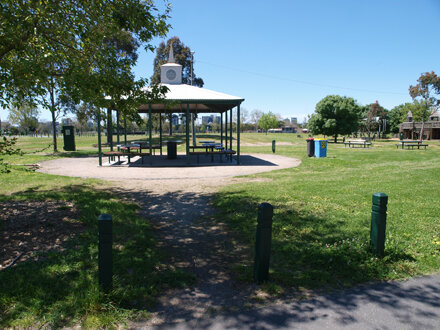
It was disappointing to be told that these areas were out of bounds for OH&S reasons and that the Forest Therapy sessions were to be on a public footpath, frequented by school groups. The only area allowable to walk off the footpath was around a lawn with BBQ’s and a playground for large family gatherings. While walking around this area my mind drew a blank on any inspiring activities – the place was offering nothing and tried and tested activity ideas felt really flat.
I could make much more sense of this experience after reading the ‘Supportive Environment Theory’ outlined by Anna-Maria Palsdottir and colleagues in Sweden, 2017. They studied the qualities of natural environments that support the rehabilitation of people with a stress-related mental disorder.
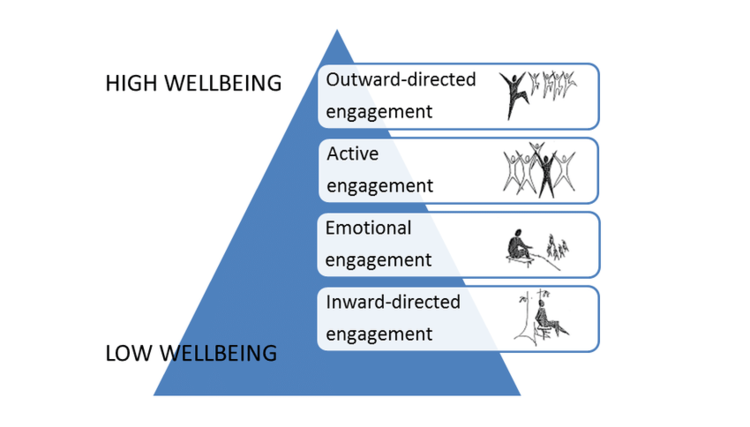
They found that natural environments had 8 restorative characteristics, which met different needs in people dependent on their stress levels.
People experiencing high levels of stress seeking recovery and healing wanted an ‘inward directed engagement’ with nature. The ideal natural environment was one that was:
A place of refuge, where you feel safe and secluded.
A serene, peaceful place with natural sounds (such as birds, water and wind).
A place that feels ‘natural’, untouched and uninfluenced by humans, with an absence of people.
People that were moderately affected by stress sought ‘emotional engagement’. A natural environment that met their needs was one where:
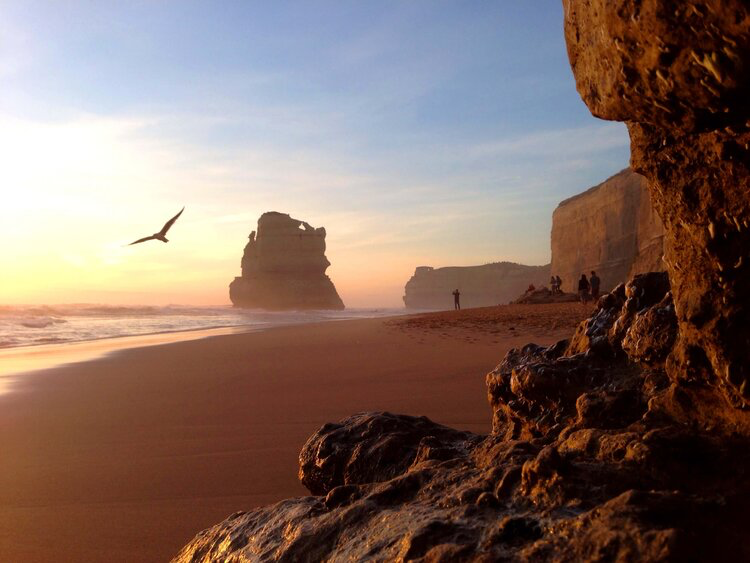
4. The environment and space prompted discovery and stimulation. One with the feeling of entering another world invoking awe (such as the darkness and silence of a pine forest or a wide open beach)
5. There was richness in species and high biodiversity of plants and animals, which sparks fascination, curiosity and inquiry.
Those who were minimally or not at all stressed craved active and outward directed engagement and wanted to watch and interact with other people. They sought places where:
6. They could see traces or evidence of human culture and influence
7. There was prospect, open spaces, views and social opportunities
8. Social spaces were specifically set up for people to meet, play and interact.
This theory perfectly explained my Forest Therapy experience! The goal of Forest Therapy is for people to de-stress by having opportunities for slowing down and introspection. The initial site I’d chosen had all of the first 5 characteristics of a natural place, which were ideal for highly and moderately stressed people seeking solitude and time away from social interaction. The site that the organisation wanted me to use for Forest Therapy had characteristics 6 to 8 and was ideal for people with no or minimal stress seeking social engagement. The latter site just couldn’t support the experience I was wanting to create – its inherent characteristics weren’t designed to do so.
This theory really helped to put into words my intuitive feeling about the different locations at the site – I now have some language around why the first site was perfect and why the second site could never have worked. The Supportive Environment Theory can be a really helpful framework for anyone planning outdoor experiences, be it for themselves or others. Clearly understanding what people need from the experience, and how stressed they are can greatly help to find the ideal natural setting to support and enhance the outdoor experience.
Like most of us I try to maintain a healthy lifestyle but I do have my moments of weakness. Devouring a greasy fast food hamburger is so satisfying in the moment but soon after I am consumed with guilt about the saturated fat, salt and calories that I have just subjected my body to.
I reason with myself that if I eat extra broccoli for dinner that night, the healthiness of the broccoli will somehow negate the unhealthiness of the hamburger. Sounds logical.
But maybe there’s a simpler approach that doesn’t involve broccoli. What if, rather than eating the hamburger I replaced it with a fruit salad? Even without empirical science to test this, intuitively this seems healthier than eating the hamburger in the first place. If I make this replacement just once, I probably won’t see much of a health benefit. But if I replace my hamburger binge with a fruit salad two or three times a week for a number of years, it’s safe to expect a reasonable net health benefit. Even if I still choose to have a hamburger a couple of nights a week.
You may be nodding your head thinking ‘yes, nothing overly controversial here’ – the idea of replacing an unhealthy action with a healthier one is probably one that we’re all familiar with when it comes to our diet. But what excites me is applying this idea of replacement to another profoundly important area our lives when it comes to our health – and that is replacing our recreational screen time with being outdoors in a natural environment.
A rapidly amounting mass of international research indicates that our current behavioural usage of screen technology is related to a string of health issues such as myopia, sleep disruption, attention deficit disorder, anxiety, depression, poor self esteem and physical issues such as less robust limbs, weight gain and associated cardiovascular disease ……the list goes on. On the contrary an equally impressive body of international evidence is revealing the health and well-being benefits of spending time in outdoor natural environments, such as reducing anxiety, stress and chronic inflammation, improving immune system functioning and enhancing brain function, sensory awareness and feelings of wellbeing.
For long term health benefits there needs to be some long term behaviour change but it’s not always that easy to squeeze in new time slots in an already over-scheduled life.
This is where the value of replacement is so important … think of times during the week that you’re in front of a screen and it is not absolutely necessary to be there. Here are some replacement options to ponder:
5 mins – if that is all you can spare from the microchips (a bit embarrassing) then take a walk to a window with a view of the green stuff or close your eyes in a quiet place and remember a happy time you had in the outdoors.
15 mins – the time that it takes you to play a game of Solitaire, swap it for a walk in the back garden, the tree lined street or a play with the dog (but don’t kick it because you lost Solitaire!)
30 mins – replace Facebook with a walk in the park or sitting in your back garden watching something that you normally spray like the bees, ants, flies or spiders going about their daily business keeping humans alive.
1 hour – now you are starting to show some commitment to your health. Get outside and turn your phone off, find a park, a creek, an urban forest or a nursery. Take some deep breaths, walk…. but walk slowly like you’re not late for your next Board meeting, look up – see the blue sky and clouds, look down – see the grass and leaves. Observe the birds, insects, flies on the dog poo or your own heartbeat. Tell yourself how good this is for you because you are doing it and you’re not in front of the information overload window.
Hey you might even start to feel a little less anxious, a bit more chilled, a bit less angry with the driver in front or a little more in touch with yourself.
I think my favourite practice from the training in becoming a Forest Therapy Guide was keeping a nature journal. It was such a fresh, fun and engaging way to learn about the natural world and quickly improved my observational skills, curiosity and knowledge. Here are some of the reasons I am such a fan of keeping a nature journal:
If this has piqued your interest in keeping a nature journal, fantastic!
There are so many resources out there to give you ideas and help you on your way.
John Muir Laws is a passionate advocate of nature journals, and has engaging videos on youtube chock full of practical ideas and tips. You can watch him here.
Paula Peeters also has a great free- ebook with ideas on how to get started with a nature journal, which you can download here.